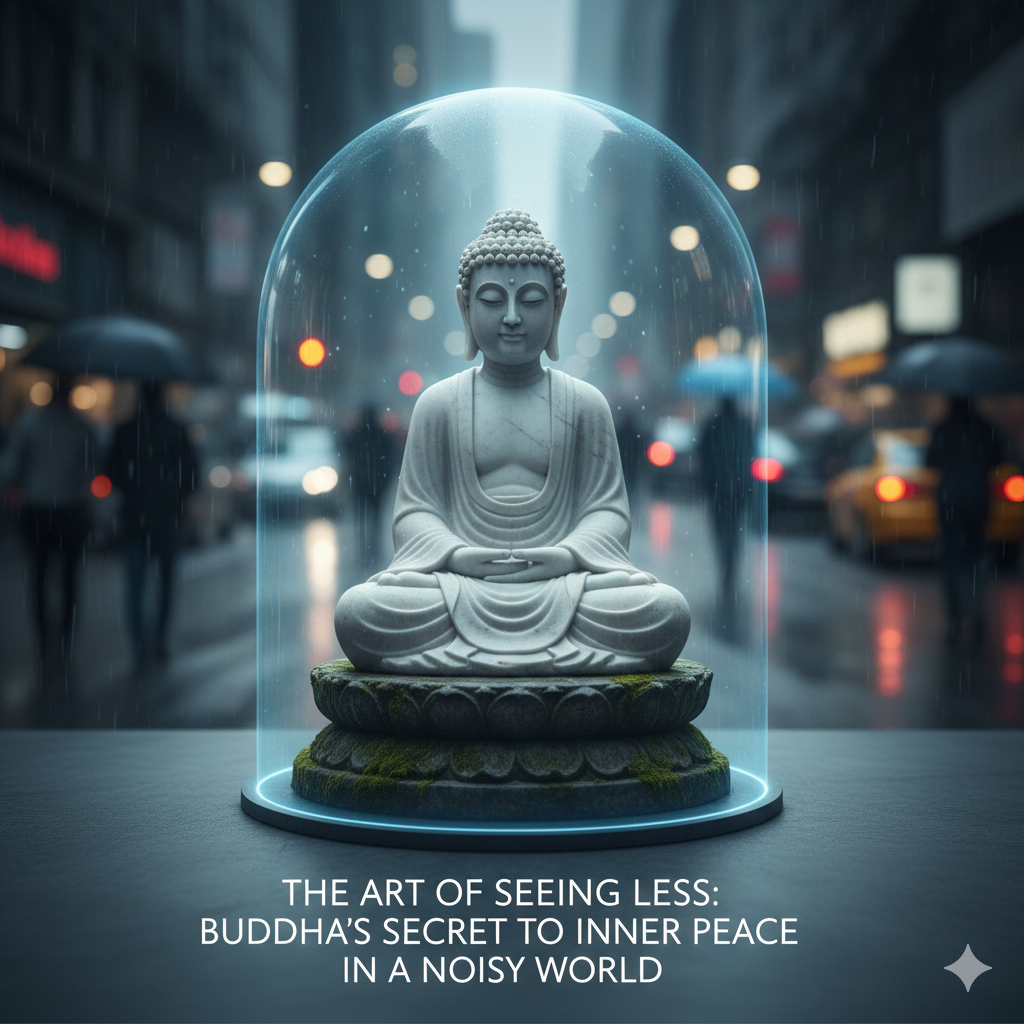
In today’s world, we are constantly told to see more, do more, and want more. From childhood, most of us grow up hearing that true success lies in achieving big goals buying a grand house, owning luxury cars, building wealth, and earning social validation. We equate happiness with external achievement.
But the Buddha’s wisdom points us in the opposite direction. He once said, “Do not look more than four steps ahead.” At first, this may sound like advice to stop planning for the future. In truth, it means something deeper: Do not carry the entire future’s burden in your present mind.
The Weight of Seeing Too Far Ahead
When we try to see everything career, money, relationships, success we often lose sight of the present. The mind begins to race ahead, worrying about what might or might not happen. Before we even take one real step forward, we feel mentally exhausted.
Buddha’s teaching wasn’t an instruction to abandon ambition or discipline. It was a reminder of balance what he called sanyam, or self-restraint. The ability to know how much is enough.
Modern life glorifies excess: more information, more attention, more desires. The Buddha reminds us that more is not always better. Sometimes, peace is found not by adding but by subtracting by reducing what is unnecessary.
The Discipline of What We Allow In
Buddha also said, “Do not listen to what is not worth listening to.”
In ancient times, this might have referred to gossip or idle talk. But in our era, it extends to the endless noise of digital life social media arguments, negative news cycles, viral controversies, and online criticism.
We absorb thousands of voices every day, many of them meaningless or harmful. Subtly, they shape our moods, beliefs, and sense of self worth. When we constantly hear gossip, complaining, and judgment, we confuse other people’s noise for our own thoughts.
Eventually, the mind becomes crowded. There’s no silence left inside.
The Buddha’s advice here is not about indifference it’s about protecting mental clarity. Listening deliberately is an act of selfrespect. Choose voices that uplift, not drain you. Choose conversations that strengthen peace, not insecurity.
Detachment Beyond Physical Touch
Another profound teaching is: “Do not touch what is not worth touching.”
While this can be understood literally, its truest interpretation is emotional and spiritual. Buddha referred to letting go of attachments that disrupt inner balance unhealthy relationships, toxic comparisons, habits that dull awareness, and desires that never end.
Not everything deserves our emotional energy. When we become attached to every situation, opportunity, or person, we lose control of our own mind. As the Buddha often taught, attachment is the source of suffering not because the world is bad, but because we cling too tightly to things that are temporary.
To live with peace, we must learn to pause before touching before engaging, committing, reacting, or absorbing energy that doesn’t serve growth.
The Wisdom of “Enough”
According to the Buddha, peace isn’t earned through more it’s revealed through less.
We are not unhappy because we have too little. We are unhappy because we are chasing what we don’t truly need. More possessions, more social approval, more recognition, more stimulation each new layer of “want” adds another layer of restlessness.
When we stop running, the mind begins to heal itself. Slowly, new clarity appears.
- The mind feels lighter.
- Thoughts slow down.
- Sleep becomes natural and deep.
- Relationships feel less heavy, less transactional.
- The heart opens to simplicity.
This is what the Buddha called “the rain of peace.” Peace doesn’t arrive from outer achievements but from inner equilibrium the ability to see clearly what is necessary and release what is not.
Simplicity Is Not Poverty
Sometimes people misinterpret these teachings as encouragement to give up ambition or stop dreaming. That’s not what Buddha meant.
He didn’t ask us to avoid progress but to avoid possession by progress when your goals start controlling you instead of inspiring you.
To live simply doesn’t mean living small. It means living wisely. You can still build a career, earn wealth, or live comfortably but with awareness that these things are tools, not the purpose of life. The real measure of success is not how much you own, but how little noise you carry within.
The Modern Relevance
In the 21st century, Buddha’s 2,500 year old message feels newer than ever. We are surrounded by choices, content, and constant comparison. Modern culture quietly tells us that fulfillment comes from expansion earning more, knowing more, doing more.
But expansion without direction becomes chaos. Buddha offers the missing counterbalance: contraction. The ability to draw inward, say no, and create boundaries for mindfulness.
Imagine applying these principles today:
- Seeing only four steps ahead focusing on today’s effort instead of tomorrow’s anxiety.
- Listening only to what strengthens wisdom and kindness.
- Touching only what nurtures inner balance.
Life would not shrink; it would sharpen. The mind would stop scattering across thousands of digital threads and start gathering into one powerful current of attention.
That current is peace.
The Simple Truth
You are not restless because life is difficult.
You are restless because you have made unnecessary things important.
The path to clarity begins when you stop chasing what adds noise.
When you see less, want less, and hold less, life naturally becomes simpler, deeper, and far more peaceful.
And perhaps that is what Buddha truly meant to walk four steps at a time, mindfully and freely, without the weight of everything that lies beyond.